
Duolingo Chess, as of August 2026, is a free course built into the main Duolingo app: a mix of puzzles and short matches against an in app coach character, designed to take a complete beginner to roughly 1500 Elo, which Duolingo itself calls "a solid intermediate level." That is what most people typing "duolingo chess" into a search bar want to know. The rest of this page covers how the course got here since June 2025, what its 75 percent puzzle and 25 percent match structure teaches, who it suits, what it costs, and where that 1500 Elo target sits relative to the rest of chess improvement, including a number of our own that lands right on top of it.
Two different "Duolingo Chess" show up in search results
Much of what ranks for this query today is not about the product described above. On 1 November 2023, Duolingo's mascot characters, Duo, Zari, Lily, Oscar and Junior, became playable bots on Chess.com in twelve languages, a marketing partnership between the two companies, separate from and older than the in app course. Chess.com reported in December 2025 that the original bot partnership was being wound down as Duolingo built its own independent chess product instead. An article about "Duolingo chess" that reads like a 2023 press release, or talks about playing Duo's bot avatar on Chess.com's own site, is describing that earlier partnership, not the course this page is about.
The course covered here launched separately, inside Duolingo's own app, on 10 June 2025, first to iOS, described by Duolingo as leaving beta and becoming free to all learners. Duolingo's own positioning for it was explicit from day one: "Most chess platforms are built for competitive players. Duolingo is built for learners."
The timeline, as of August 2026
Duolingo has shipped this course in stages, and a lot of what currently ranks for "duolingo chess" predates one or more of the rows below.
| Date | What shipped | Platform |
|---|---|---|
| 10 June 2025 | Chess course leaves beta, free to all learners | iOS |
| 16 September 2025 | Android expansion (English, Spanish, French, German, Italian, Portuguese) and a Player vs Player mode announced at Duocon 2025 | Android added; PvP announced for iOS first, Android to follow |
| Late 2025 into early 2026 | PvP ("Play a Person") rolls out; reported reaching Android around February to March 2026 alongside a marketing activation in Indonesia | iOS then Android; exact iOS launch date and the precise Android date are unconfirmed in any first party source we could locate |
| 11 August 2026 | Game Review, Duolingo's first post game analysis feature for Chess, ships | iOS only at launch, Android "coming soon," no date given; confirmed live on both platforms as of our 4 September 2026 check, exact Android date unpublished |
Two of those rows deserve a caution rather than a confident date. The Android PvP timing comes from trade and PR adjacent coverage rather than a dated Duolingo blog post, so "early 2026" is the safer claim than a specific day. One Chess.com article about the partnership, dated 1 December 2025, describes PvP as "not yet" available, which sits awkwardly next to the September 2025 announcement and later 2026 coverage of it reaching Android, either a stale republished date on that article or a slow rollout. Either way, we are not printing a single confident "PvP arrived on iOS on this date" claim, because the sources disagree and we could not resolve them to one first party date.
What the 75/25 course structure actually teaches
Per Duolingo's own course description, the curriculum runs about 75 percent puzzles and 25 percent mini and full length matches against Oscar, the in app coach character. The puzzle heavy split is the tell: this is a course built to install patterns through repetition first, then let a learner apply those patterns in short, contained matches, rather than one built around long, unsupervised games from day one. It lines up with the audience Duolingo says it is building for: prioritizing a beginner completing lessons and staying in the habit over throwing a beginner into open ended competitive play immediately. Whether that tradeoff suits you depends entirely on what you already know and what you want out of the time you spend.
Duolingo added one more piece to that loop on 11 August 2026: Game Review, a post game analysis feature that sorts a finished match into good moves, missed opportunities and mistakes. It launched on iOS only; as of our 4 September 2026 check it runs on both platforms. We already broke that feature down in full, including a first-hand walkthrough of what it actually shows and where it stops; see our Game Review breakdown rather than repeat it here.
PvP, real opponents on both platforms, is the other big addition since launch, and it comes with real limits that a detailed play tester's account has documented, a single fixed time control, no way to offer a draw, no way to review a finished match afterward. That deserves its own page rather than a rushed paragraph here.
Who Duolingo Chess is good for
A complete beginner who has never played a full game and wants a low stakes, gamified way to learn the pieces, basic tactics, and enough structure to play a first real game, without also learning a separate site's interface, streak system and account setup. That audience is not small: chess sits inside the same app Duolingo already uses to teach dozens of languages to an enormous existing user base, large enough that the main Duolingo app carries a 4.7 star average across 5.4 million ratings on the US App Store, an app wide figure rather than a chess specific one, since there is no separate chess rating anywhere on the store.
The honest case for Duolingo here is not faint praise. Habit formation is a hard problem in chess improvement, arguably harder than producing good instructional content, and Duolingo has spent over a decade building the mechanics that get people to show up daily. Folding chess into an app millions of people already open, with its existing streak and XP system doing the work of getting someone back to the board tomorrow, is a strength a standalone chess app has to build from nothing. If your goal is simply to start playing chess and keep coming back to it, this is a legitimately good on ramp.
What it is not built for, by its own description, is a player who already plays and wants to keep climbing. That is not a flaw so much as a boundary Duolingo drew on purpose: it says plainly that it built the course for learners, not competitive players.
Where the boundary shows up in the product itself
We ran the onboarding flow and a full match ourselves on 3 September 2026, and the ceiling Duolingo states in words also shows up as a design choice at three separate points before you ever reach it.
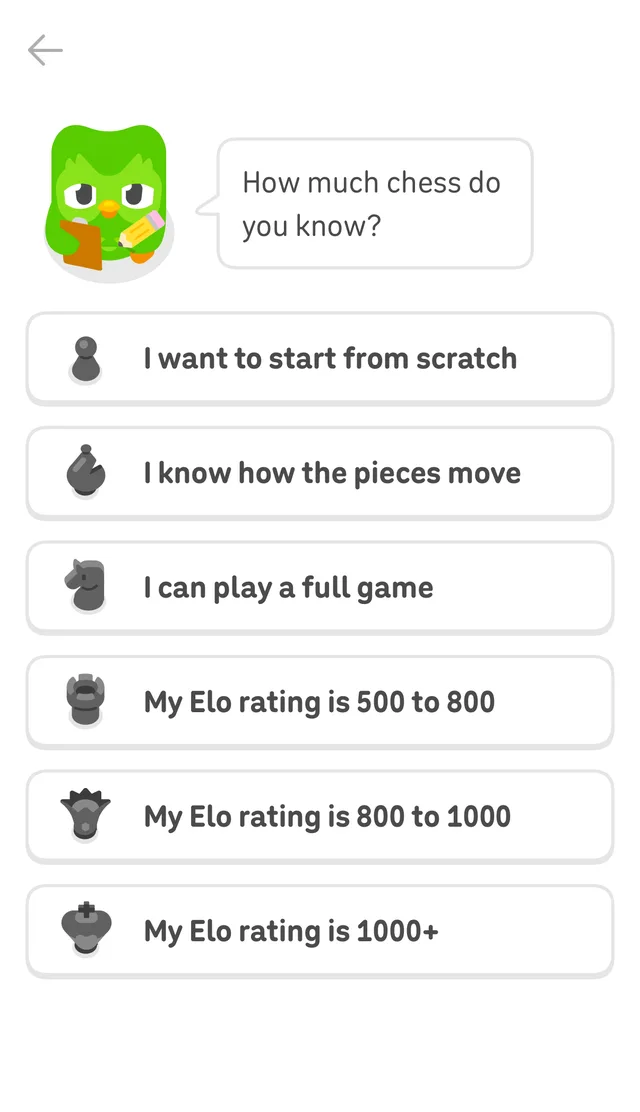
Captured 3 September 2026. Six options total, and the top band is open-ended: "My Elo rating is 1000+" covers everyone from a 1000 to a titled player identically.
The self-assessment on the second onboarding screen asks "How much chess do you know?" with six options: "I want to start from scratch," "I know how the pieces move," "I can play a full game," "My Elo rating is 500 to 800," "My Elo rating is 800 to 1000," and "My Elo rating is 1000+." That last band has no ceiling of its own. A player at 1200 and a player at 2000 place themselves identically, into a course whose own stated target is roughly 1500, which is consistent with a product built to take a beginner to intermediate rather than to place or serve players who are already there.
The very next screen asks "Why are you learning Chess?" and lists six reasons plus "Other": "Learn something new," "Compete in tournaments," "Play with friends," "Improve my chess skills," "Train my brain," and "Just for fun." Offering tournament competition as a reason to sign up sits oddly next to a course that, by its own description a few screens later, is built for learners rather than competitive players. Someone who picks that option is being asked to state a goal the course was not designed to serve.
Once onboarding finishes, Duolingo's own choice screen offers two starting points side by side, "Do a lesson" and "Play a chess match" against "our adaptive bot, Oscar," and tags the match option "Recommended." A brand-new signup, including one who just selected "start from scratch," is pointed at playing before the course points them at a lesson.
We also measured what one match does to the number itself. Starting from the floor of the "500 to 800" self-assessment band, Duolingo placed us at 500 Elo going in, paired us against an opponent shown at 485 Elo, and a checkmate later, we came out at 668, a 168 point jump from a single game. That match ran on the single fixed time control PvP uses, ten minutes per side with no option to change it, which a detailed third-party play-tester's account has also documented, alongside the same account's finding that there is no way to offer a draw and no way to review a finished match afterward inside Duolingo itself. Our own clock read 7:56 and 7:47 remaining moments after checkmate, consistent with that ten-minute allotment and a fairly quick game. A number that moves 168 points on one result is a useful habit hook, and it is a different kind of number from a rating that has stabilized over dozens of games, which is worth knowing before reading too much into an early Duolingo Elo.
What it costs, and the "Super exclusive" claim that is not true
Duolingo Chess is free, "consistent with Duolingo's other courses," per Duolingo's own description, with no chess specific paywall on the course content. Some secondary coverage has floated the idea that Chess is a Super Duolingo exclusive, gated behind Duolingo's paid subscription. We could not confirm that in any first party source, and it directly contradicts Duolingo's own statement that the course is free. The likelier explanation is simpler: Duolingo replaced its old Hearts system with an app wide Energy system, twenty five starting units, one unit spent per question regardless of whether you get it right, refilled by ads, gems, or an unlimited Super subscription. That cap applies to every course in the app, chess included, exactly the way it applies to Spanish or Japanese: a Duolingo wide mechanic you will eventually hit no matter the course, not a chess specific gate. Reporting that treats it as a chess only exclusive is describing the same platform wide limit inaccurately.
The 1500 Elo ceiling, and which direction it is moving
Duolingo states its own target plainly: the course is designed to take a complete beginner to roughly 1500 Elo, described in Duolingo's own words as "a solid intermediate level." For someone who started at zero, reaching a genuine 1500 level of play through a free, gamified course that also kept you coming back daily is a legitimate achievement, not a hollow round number.
It is also, by design, a stopping point rather than an open ended ceiling. A course engineered to take a beginner to intermediate is not the same product as one engineered to take an intermediate to advanced, and Duolingo has never claimed otherwise. Once you are genuinely playing at or near 1500, the course that got you there was not built to keep teaching you past it.
That ceiling is not fixed in place, and treating it as permanent would misdescribe a product shipping new pieces every few months. Since the June 2025 launch, Duolingo added Android and more languages within three months, then PvP against real people, then, in August 2026, its first post game analysis feature. Duolingo's own blog has said it hopes to add things like Elo placement tests and real time coaching if the course keeps growing. Whatever the current ceiling looks like in August 2026, the direction Duolingo is moving is toward closing the gap between beginner course and ongoing improvement tool, not away from it.
What our own data shows, right where that ceiling sits
Chessdrive, the app we build, ships an on device version of Maia3, a human move prediction model, alongside Stockfish. We used that pairing to ask a specific question about Duolingo's own stated target: once a player actually reaches roughly 1500 Elo, does that milestone change how often they find the objectively best move in a sharp position? We are the interested party in this section, and the answer is the reason we ran the numbers rather than left the claim as marketing.
We took the finish of the Opera Game, Morphy against the Duke of Brunswick and Count Isouard, Paris 1858, a famous attacking sequence, and scored every legal move at every position with Stockfish 17 at depth 20. Separately, we ran Maia3 at seven rating bands, from 1000 to 2200, self calibrated with the real full move history of the game supplied at each step, to get each band's probability of actually playing Stockfish's top choice. We call that probability Findability. The run was checked against our own previously frozen output at selfElo 1400 across 264 compared moves and came back with a mean absolute error of 0.0024, a tight match. This is dated 28 August 2026.
Be precise about what this is and is not: one historically famous, sharply tactical game, scored exhaustively across seven rating bands, not a survey of Duolingo's own users and not a broad statistical sample of chess as a whole. Maia3 models what a rating band tends to play on average, not what any individual player would do. Treat the numbers below as a specific, real illustration of a general pattern, not a population wide average.
Across the seven non forced, non trivial positions in that finish, average Findability by rating band looks like this:
| Self rated Elo | Average Findability across 7 positions |
|---|---|
| 1000 | 16.8% |
| 1200 | 16.5% |
| 1400 | 16.4% |
| 1500 (Duolingo's own stated target) | 16.4% |
| 1800 | 16.4% |
| 2000 | 16.8% |
| 2200 | 17.7% |
That line is close to flat. A player who reaches 1500 finds Stockfish's own best move 16.4 percent of the time across these seven positions, barely different from 16.8 percent at 1000 and about a point off 17.7 percent at 2200. Arriving at 1500 does not, by itself, change how often a player sees the engine's move in a position like this one.
One position in that finish makes the point sharper, and in the opposite direction most people would guess. At move 16, White has Qb8+, a queen sacrifice that forces mate in two. The safe alternative, Qb7, keeps the queen and a large material edge without needing to calculate the mating sequence at all.
| Self rated Elo | Finds the mate, Qb8+ | Plays it safe, Qb7 |
|---|---|---|
| 1000 | 16.2% | 17.4% |
| 1200 | 15.6% | 20.8% |
| 1400 | 15.1% | 25.4% |
| 1500 | 14.6% | 28.0% |
| 1800 | 11.6% | 37.8% |
| 2000 | 9.2% | 45.2% |
| 2200 | 7.4% | 50.8% |
Finding the mate gets rarer as rating climbs, not more common. A 1500 finds Qb8+ 14.6 percent of the time, less often than a 1000 does at 16.2 percent. Meanwhile Qb7, the safe retreat, climbs steadily from 17.4 percent at 1000 to 50.8 percent at 2200: stronger players increasingly bank the win rather than calculate the mate, a defensible practical choice in a real game even though it is not the engine's top line. The pattern is not "stronger players find more" so much as "stronger players trade calculation for certainty" once they are already comfortably winning, which is its own real skill, just not the one Findability measures.
Put those two tables together and the honest reading is this: 1500 Elo is a real, worthwhile destination, and Duolingo is right to build a whole course around it. It is not, on this evidence, the point at which a player stops needing outside help to find an engine's best move. It looks more like the point where the kind of help needed changes shape, from not hanging pieces and missing one move tactics, the pattern a 75 percent puzzle course is well built to fix, to calculating concretely under pressure and trusting a forcing line you cannot immediately verify, a different and harder skill that a course built around short matches against an in app coach was never designed to drill.
For the full methodology behind Findability, including how it differs from the plain move matching accuracy Maia3 reports on its own model card, see our separate explanation of chess analysis and how we measure it.
What people move to once they are past what the course is built for
If you are a genuine beginner still working through the puzzles and matches, there is no reason to move anywhere yet, Duolingo's own course is doing the job it was built for. The decision point comes later, once you are consistently playing real games around the level Duolingo describes as its target and the improvement from lessons has slowed.
At that point, the honest options are the same ones any improving player eventually runs into. Lichess offers a full free analysis board, unlimited games and no paywall on any of it, the deepest free option available anywhere and one Duolingo Chess itself does not attempt to compete with on volume. Chess.com adds a large existing player base, its own Game Review feature, and a structured ratings and tournament system that Duolingo's own single fixed time control PvP does not currently match. Both are free to start; their own pricing pages carry the current terms for anything beyond that.
Chessdrive, the app we build, is the interested party in this paragraph and should be read as one. It pairs Stockfish with an on device Maia3 model, the same pairing behind the Findability numbers above, across practice opponents spanning 600 to 2600, so the "would a human at my level actually find this" question is something the coach can answer directly rather than leaving you to guess. The interface ships in five languages, and the coach answers in twenty. It is live on both iOS and Android, at $5.99 a month or $39.99 a year, and both plans start with a free trial. What it does not have is Duolingo's decade of habit formation mechanics or its existing daily audience.
The honest summary
Duolingo Chess, as of August 2026, is a good on ramp for a complete beginner: free, gamified, built by a company that has spent years solving the harder problem of getting people to show up. The 75 percent puzzle, 25 percent match structure is a sensible way to install patterns before asking a learner to apply them, and Duolingo's own stated target, roughly 1500 Elo, is a legitimate milestone, not a hollow number.
It is not, and was never positioned to be, a tool for taking an intermediate player toward advanced play, and Duolingo has been shipping in that direction anyway, adding real opponents and, as of this month, its first post game analysis. Our own data lands right on top of the number Duolingo picked: reaching 1500 does not meaningfully change how often a player finds an engine's best move in a sharp position, which suggests 1500 is better understood as a stage where the kind of help you need shifts, not a wall.
Update log
- 4 September 2026: Confirmed Game Review now runs on iOS and Android, a change from the iOS-only launch on 11 August 2026; Duolingo has not published the Android date. Added a first-hand section on where the 1500 Elo boundary shows up in the product itself: the onboarding self-assessment caps at "1000+," "Compete in tournaments" is offered as a signup motivation the course is not built to serve, the first choice screen recommends a match over a lesson, and one measured match moved our Elo from 500 to 668 in a single win.
Last verified: 4 September 2026, against the sources cited above, a first-hand run of onboarding and a full match, and Chessdrive's own generated Stockfish and Maia3 output described in this article. Duolingo ships new features on this course every few months; confirm current specifics on Duolingo's own pages before relying on any date here.
Frequently asked
- Is the Duolingo chess course the same thing as playing Duolingo's mascots on Chess.com?
- No. Duolingo's characters, Duo, Zari, Lily, Oscar and Junior, became playable bots on Chess.com on 1 November 2023, a marketing partnership between the two companies. The in app Duolingo Chess course is a separate, later product that launched inside Duolingo's own app on 10 June 2025. Chess.com reported in December 2025 that the original bot partnership was being wound down as Duolingo built its own independent chess product instead. Many older articles that come up for this search are about the 2023 bots, not the current course.
- Is Duolingo Chess free?
- Yes. Duolingo describes the course as free, consistent with Duolingo's other courses, with no chess specific paywall. It runs on the same app wide Energy system as every other Duolingo course, twenty five starting units that refill through ads, gems, or a Super Duolingo subscription, a platform wide limit rather than something specific to chess. A claim that circulates online, that Chess is a Super Duolingo exclusive, contradicts Duolingo's own statement and appears to be inaccurate.
- What rating does Duolingo Chess get you to?
- Duolingo states the course is designed to take a complete beginner to roughly 1500 Elo, which it calls a solid intermediate level. Our own data, generated separately with Chessdrive's Stockfish and Maia3 pipeline, suggests that number is a real milestone but not a point at which a player stops needing outside help: at selfElo 1500, a player finds an engine's own best move in a sharp position about 16.4 percent of the time in our test position, close to the same rate at 1000 and at 2200.
- Where do I actually find Duolingo Chess?
- Inside the main Duolingo app, not as a separate download. Its App Store and Google Play listing names vary by storefront, so there is no single listing name worth quoting here, but chess lives inside whichever Duolingo app you already have installed. It is also reachable on the web at duolingo.com/chess, though Duolingo's own play chess page indicates real opponent matches against people are not yet available on the web version, lessons and puzzles only, as of this check.
- Is Duolingo Chess good if I already know how to play?
- It depends what you want from it. Duolingo built the course explicitly for learners rather than competitive players, and its own stated ceiling sits around 1500 Elo. If you already play above that level and want to keep improving your rating, the course is not built for that stage. If you already know the rules and just want a low pressure, gamified way to sharpen basic patterns, plenty of casual players genuinely enjoy it regardless of level, so treat this as a mismatch for a specific goal, rating improvement, rather than a verdict on the app itself.
- Does Duolingo Chess explain why a move is right or wrong?
- More than it used to. Before 11 August 2026 it had no post game analysis at all. Since then, Game Review sorts a finished match into good moves, missed opportunities and mistakes, narrated by Oscar. It launched on iOS only, with Android described as coming soon and no date given; checked again on 4 September 2026, Duolingo's own announcement now reads available on iOS and Android. It gives a short explanation for each flagged mistake. We cover exactly what it shows, including a first-hand walkthrough of a captured review, in our full Game Review breakdown.
Reached Duolingo's target and wondering what changes now?
Chessdrive pairs Stockfish with an ELO aware Maia3 model so you can see whether a move was actually findable at your rating, not just whether it was correct. Free to start, on iOS and Android.
Keep reading
Updated